Why Primer Matters in PVC Plumbing
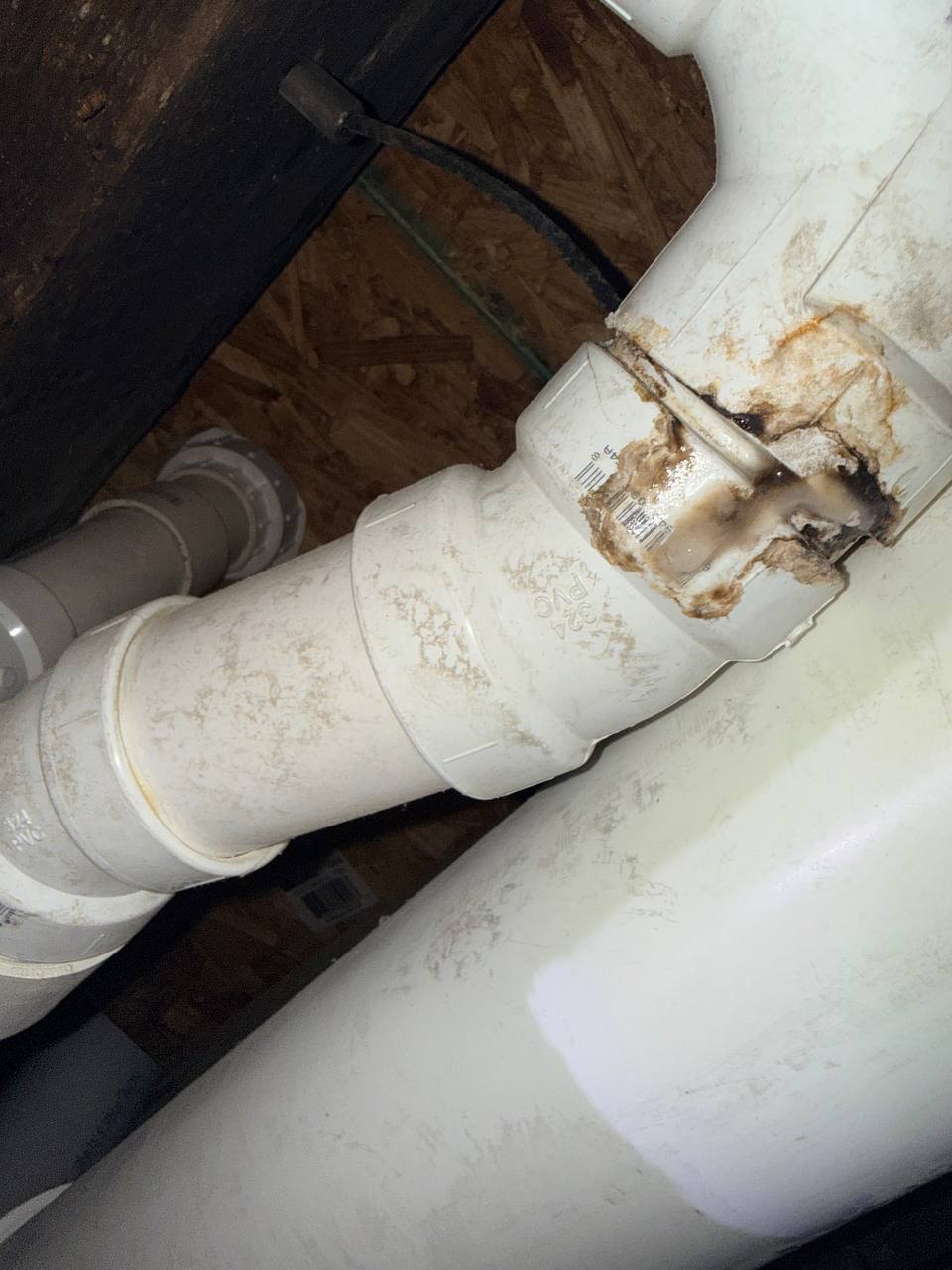
Down here in the Triangle — Raleigh, Garner, Cary, and all of Wake and Johnston County — a huge share of our older homes drain through white PVC pipe running through a crawl space. And I've got a photo of the single most common joint failure I see under these houses. It's from a crawl space right here in the area, and it tells the whole story of why primer isn't an optional step. It is the step.
What primer actually does
Everybody calls it "glue." It isn't. PVC solvent cement doesn't dry and stick like wood glue — it melts the surfaces it touches and welds two pieces of PVC into one continuous piece of plastic. A properly made joint is stronger than the pipe around it.
But cement alone can't get through the skin of a PVC fitting. That glossy factory surface resists softening, and cement sits on top of it instead of biting in. That's what primer is for: it's a blend of solvents (tetrahydrofuran and similar, dyed purple in most pros' cans) that dissolves and softens the outer layer of both the pipe and the fitting. Prime both surfaces, and the cement that follows can penetrate deep into softened plastic on both sides of the seam. Pipe and fitting chemically fuse into one piece — no seam left for water to find.
What happens without primer
Now look back at the photo. That's exactly what's missing. When someone skips primer, the cement still melts a little and still squeezes out of the seam when the pipe bottoms into the hub — that's the dried, frosted smear you can see along the joint. It looks convincing. It looks "done."
But underneath that squeeze-out, the two surfaces never fused. There's a thin unfused seam running all the way around the hub — the dark gap and discoloration visible in the photo. Wastewater finds that seam on the very first flush. In a damp crawl space, it weeps slowly, stains everything it touches, grows the brown residue you see, and eventually lets go. Under a house in Wake County — where crawl-space humidity runs high most of the year — those joints fail slowly and quietly until someone notices a smell or a wet spot on the subfloor.
The one-step product trap
Here's the mistake I see most from handyman-grade work around Raleigh, Garner, and Cary: the "primer and cement in one" cans — the all-in-one products marketed as a shortcut. Homeowners reach for them because one can is easier, and the label says primer is built in.
They don't do the same job, especially on drain work. The solvent dose in a one-step product is tuned thin so it can carry the cement without pre-softening the fitting surface the way real primer does. On Sch. 40 and especially on big DWV fittings — like the Sch. 32 drain hub in this photo — one-step products don't dissolve enough surface for a deep fusion. The joint sets up sitting in that unfused seam. Some of them hold for months. They all show up in a crawl space eventually.
The plumbing codes in North Carolina communities — Raleigh, Garner, Cary, Apex, Wake Forest, Clayton, and the rest of Wake and Johnston County — follow plumbing standards that call for primer on PVC joints for a reason. Purple primer isn't decoration. It's the step that makes the weld.
How a proper joint is made
- Cut clean and square — a ragged or crushed cut never seats fully in the hub.
- Deburr inside and out — burrs catch debris and start clogs.
- Dry-fit first — the pipe should bottom out snug with no force.
- Prime both surfaces — pipe end and the inside of the fitting hub, until the glossy surface is dulled and soft.
- Cement while the primer is still wet — a full even coat on both surfaces, no dry spots.
- Push to the mark and twist a quarter turn — that spreads the cement and confirms full bottoming.
- Wipe the squeeze-out — and check that the bead is continuous all the way around.
That quarter-turn bead of cement squeezing out evenly around the whole hub is the signature of a fused joint. A gappy, lumpy squeeze-out — like the one in the photo — is the signature of a seam that was never welded shut.
Why crawl spaces make bad joints worse
Crawl spaces are where sloppy joints get found out. It's dark, it's tight, you're working overhead with your arms above your shoulders — and primer is the step people skip when they're halfway through a long day under a house. Add our local conditions: high humidity in Wake County crawl spaces, condensation on cold drain lines, and soil that stays damp around the foundation after one of our heavy rains. A marginal joint in a dry attic might survive for years. A marginal joint under a home in Garner or Clayton sits in damp air with almost no airflow. It never gets the chance to dry out and re-harden.
Signs a drain joint under your house is failing
- Sewer odor in a room, closet, or the whole first floor
- Damp or stained insulation under the floor in the crawl space
- Brown staining and residue at fittings — exactly what's in the photo
- Gurgling drains or slow fixtures on one side of the house
- Soft spots or warping in a hardwood floor above the run
If you're smelling something or seeing stains and you're calling around for plumbing repair in Garner NC, a crawl space drain leak in Raleigh NC, or a drain repipe estimate in Cary NC — or anywhere from Apex and Wake Forest down to Clayton and Johnston County — ask whoever quotes the job one simple question: "Do you prime PVC joints, or do you use a one-step product?" A plumber who says "primer, both surfaces, every joint" is telling you they weld their work. One who shrugs is telling you what's under your house in ten years.
Have a plumbing mystery you want decoded? Email [email protected].